
How Long do WRs Stand?
An analysis of how long it is from one WR to the next.

“It’s not who’s put up the fastest time in the world that year, or who’s put up the fastest time in the previous four years, but who can get their hand on the wall first today.” – Nathan Adrian
Hi all! Welcome back to “From the Blocks.” Last time, I began reviewing the dataset of all long course swimming world records. In gearing up for World Championships (swimming starts July 27!) I started looking at frequency of WRs and diving deeper into how much time passed between records broken by event.
This doesn’t necessarily mean these swimmers are most likely to break WRs at Worlds. It certainly makes me excited though! And since you are reading this, I bet you are excited, too.
As one of my favorite sprinters of all time, Nathan Adrian, pointed out above that it isn’t necessarily about breaking the WR, it’s about being the fastest right here, right now. Good swimmers, like any successful athletes, have goals, of course. Summer and Katie no doubt have their goals going into Worlds down to the hundredth of a second. For the sake of the medal count, though, it’s who touches the wall first, WR or not. This doesn’t stop me from being curious about WRs!
This post will include a few more charts and some code chunks (my code is cleaned up for this post, but check out my GitHub page for the whole script!). I have been a Python girly for the last few years and recently decided to revisit R (where I was raised) to:
Challenge myself (for you non-coders out there – R is not really a code language, it’s a command language, and is not object-oriented the way Python is), and
Make some nice charts (we love plotly! pretty colors!).
I’m not going to lie. When I started working on calculating dates and how much time passed between WRs for each event and realized I had EVEN MORE manual data work to do, I let out a sigh and rolled my eyes. Haven’t I done enough! But no. I have not. And the manual data analysis is never over! It turns out that in saving my working file from XLSX to CSV, dates from the 1900s were passed as 2000s dates. How did I find this out? I checked my work. I do my due diligence. You’re welcome.
A New Variable
I created a new variable that calculates the number of days between WRs. Logic tells us that the first ranking for each event by sex is NA, since it is the first WR, or “World’s Best Time.” I use the package dplyr (the little %>% is called a pipe) for legible and organized data manipulation.
wr %>%
  arrange(Event, Date) %>%
  group_by(Event, Sex) %>%
  mutate(DaysPassed = as.numeric(Date - lag(Date))) %>%
  ungroup()
To summarize, I looked at the average days passed between WRs for each stroke (across both sexes), and for each event. It may not really mean anything, but that’s the fun of statistics. Sometimes it’s just about spewing random facts to friends and family and them saying “Wow! So cool!” as they try to leave the conversation.
First up, average days passed between WRs by stroke.
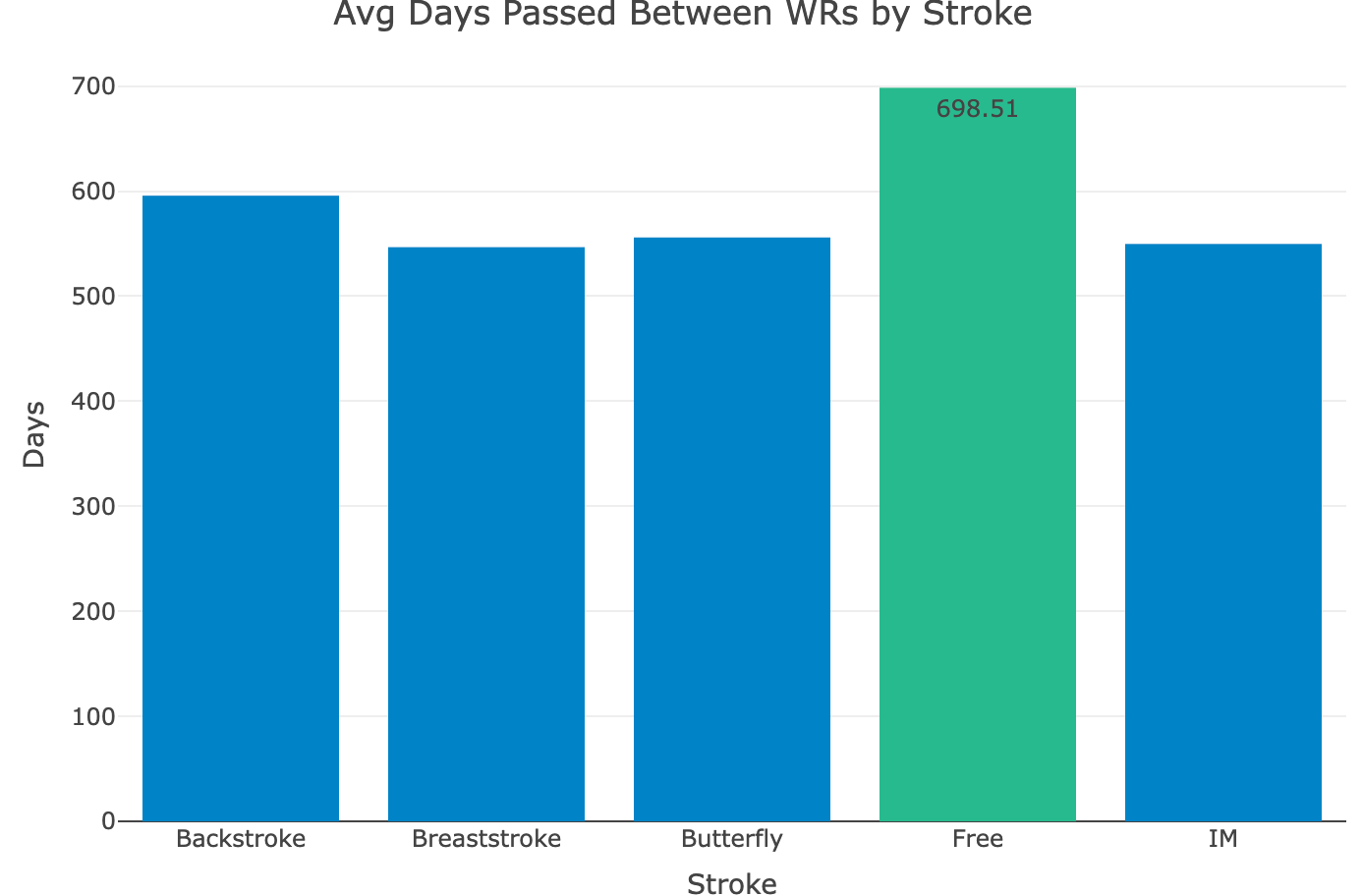
I think I expected an off stroke rather than Freestyle here, since there are more Freestyle events swum. It could be that swimming these so quickly (i.e., faster than anyone ever before) is that much more impressive.
Next, I looked at each event.
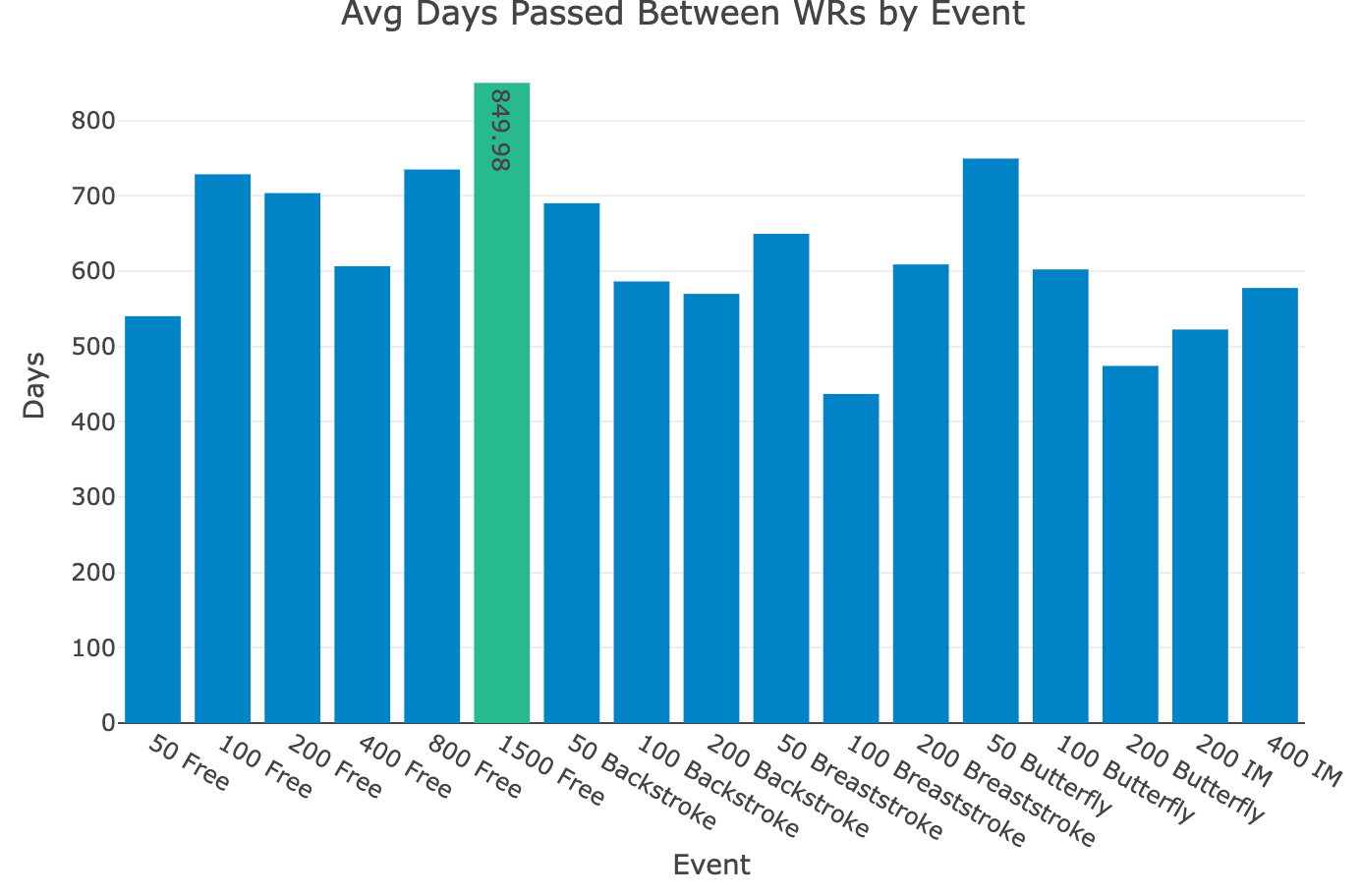
The mile takes the cake here. This wasn’t as surprising, since the mile is not swum that often. In fact, until 2021 in Tokyo, the women didn’t swim it in the Olympics, meaning less opportunity to break WRs.
The 400 Free
Speaking of Katie Ledecky, I love looking at the women’s 400 Freestyle. In my head, the WR has been broken a bunch lately. If “lately” is since the tech suit ban, it’s been broken 7 times, 3 times by Katie Ledecky (USA) and twice each by Summer McIntosh (CAN) and Ariarne Titmus (AUS). After the queen Federica Pellegrini was the first under 4 minutes in 2009, it took 1,840 days to break it again, when Ledecky appeared on the scene and started slaying.
womens_400_Free = wr %>%
  filter(Event == "400 Free") %>%
  filter(Date > "2010-01-01") %>%
  filter(Sex == "F") %>%
  select(Name, Time, Nationality, Meet, Date, DaysPassed)
In fact, after Ledecky’s most recent 400 Free WR it took even longer for someone else to break it – almost 6 years!
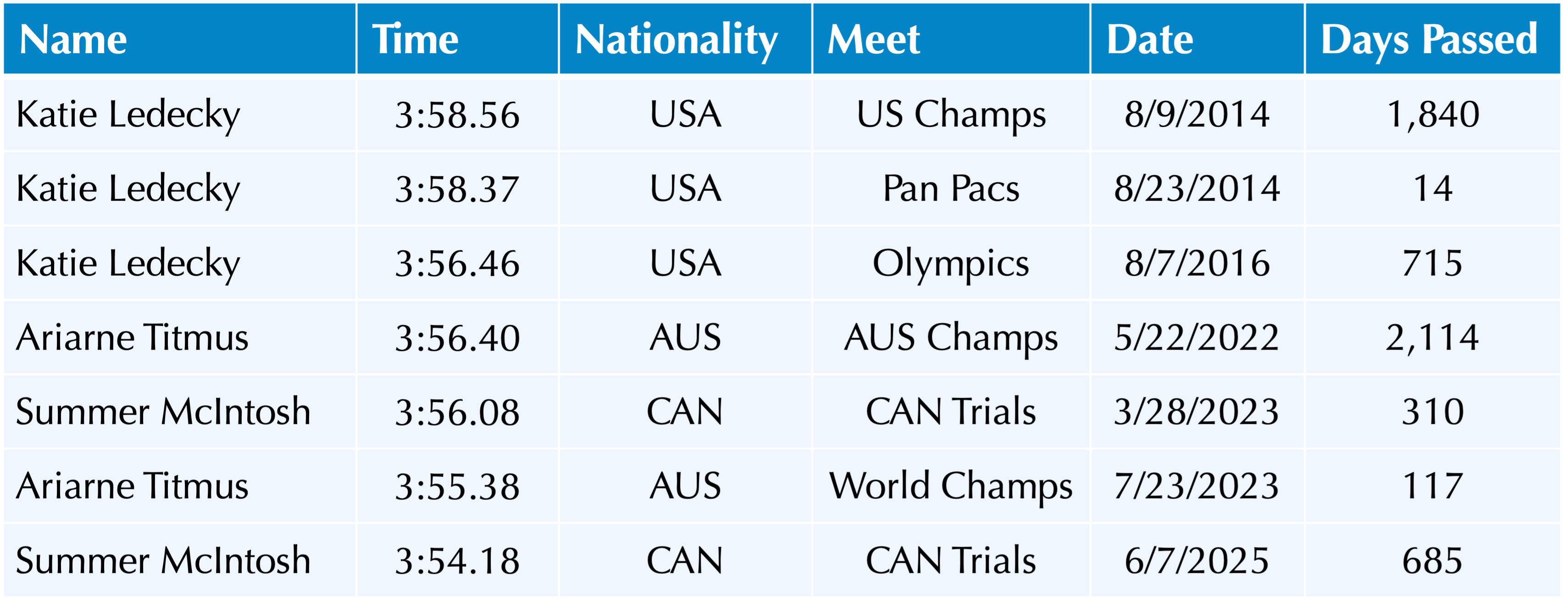
Breaking the men’s 400 Free WR has been much rarer in recent years. Until April of this year, it was still Paul Biedermann’s suited record from the 2009 Worlds (the meet that led them to ban the super suit). It took 5,739 days to break it, when Lukas Martens took down the record and broke 3:40 for the first time at the Stockholm Open. At least it stayed in the family (sort of – they are both German).
Most and Least Days
I discovered that tidbit by looking for the following. Of current WRs, which ones took the most and least amount of time to break, from the previous WR (most and least number of days from second most recent WR to most recent WR)? Lukas was the answer to the first part of the question.
# find the latest WR for each event/sex
latest_event = wr %>%
  group_by(Event, Sex) %>%
  filter(Rank == max(Rank)) %>%
  ungroup()

# current WR that was broken most days after previous one
recent_longest = latest_event %>%
  filter(DaysPassed == max(DaysPassed))

# current WR that was broken least days after previous one
recent_shortest = latest_event %>%
  filter(DaysPassed == min(DaysPassed))
The current WRs that were broken the least amount of time after the previous WR were broken in the same day (DaysPassed = 0). Gretchen Walsh, the current 100 Butterfly WR holder (and greatest NCAA swimmer ever), broke the WR (her own) in prelims of the Fort Lauderdale TYR Pro Swim Series, and then again that evening in finals.
Adam Peaty did the same thing in 2017 at World Champs, breaking the 50 Breast WR (his own) in prelims, and again that evening in semifinals. If only I had the minute count from prelims to finals for these two meets to break the tie!
I also looked at the overall longest and shortest standing WRs. Of course, we just looked at some of the shortest ones, and there are actually 56 total instances of a WR being broken in the same day as the previous one.
The longest WR to stand, according to my dataset, was the women’s 100 Freestyle WR broken after about 20 years by Australia’s Dawn Fraser in 1956 (obviously in the late ‘30s and early ‘40s fast swimming was not a priority for the world). She later became the first woman to break the 1-minute barrier in the 100 Free and held the record for over 15 years (breaking it multiple times herself). It’s interesting that a record that took so long to break was then broken so many times, by the same person, and then not again for 8 years (when Shane Gould broke it in 1972).
I hope this prepares you all for watching World Championships next week. I can’t say there is any likelihood or not of more records being broken, but I can tell you I will be glued to the tv when I can watch and updating my dataset if (and when???) WRs are broken. You’re all thinking it, so I’ll just say it - will Ledecky reclaim her 400 Free WR, or will the youngsters keep it out of reach?
The year after the Olympics means some veterans are taking it easy and some new kids are showing up to see if they can dominate the way the US ought to. Let’s just pray that the men get an individual gold medal much earlier in the meet than they did at the Paris Olympics. Go USA!
Thanks for tuning in. Until next time!